
It's February here in Lima and for those living below the Equator's belt it's summertime, but Marco you say "what makes summer in February so special?" The answer is simple my loyal readers, CARNIVAL! Now I'm not going to go into detail about carnival in Lima just yet but I have managed to find a few videos that provide a good visual base to what I will later discuss in more depth.
Showing posts with label history. Show all posts
Showing posts with label history. Show all posts


The blog Una Lima Que Se Fue is a vault full wonderful artifacts from Lima's past. As the city of Lima continues to evolve the relics of a beautiful city slowly begin to erode from sight. Thankfully this website is doing what few others have attempted and that is archiving the cities history and past, through the many aging photographs and documents.
Today I found a photo that really caught my eye and just had to share it with you. I'm not quite sure who the hooded women behind the baby is but the title reads: "Another Wet Nurse". I'm not entirely sure what a wet nurse is but she looks like some kind of nanny. Look it up on Wikipedia if you really want to know.

Special thanks to blogger Juancho over at Camina El Autor, for posting this video made by PBS he discovered recently. The film is from the PBS TV show "A Moment of Luxury" hosted by Bill Stubbs, which has visited Lima to highlight some of the cities beautiful interiors of some of it's oldest buildings, along with other popular sites. The good news is that it's in English, something not always available on this site when it comes to videos.
The video is fairly interesting for it's footage and information if you can overlook all the additional side commentary.
Watch the full episode. See more Moment of Luxury.
While walking along Jiron de la Union (in downtown Lima) with Zdenka, we passed the famous Casa de Higgins (house of Higgins). The main wooden doors were open and a sign stating "free entrance" hung above, inside was the magnificent house was an exhibit dedicated to the famous journalist Doris Gibson (28 April 1910–23 August 2008). She was also the founder and editor of the popular weekly news magazine Caretas.
 During the tour of the house and the exhibit I came across a historical timeline of Caretas which had one date that caught my attention. The date was 1983 and next to it read "Death of Journalists at Uchuraccay", having never heard of this incident I quickly wrote down the date and info for further investigation.

Below is a excerpt from Quinoa Films website that gives more information about the incident, also they have managed to complete a subtitled trailer of the film which can be found below.
"
This is an independent documentary about a group of journalists, who became part of their own story when they were murdered in 1983 in Uchuraccay, a remote hamlet in the Andes of Peru, as they were investigating rumors of extrajudicial killing by the military. It took place in the midst of violent warfare between the Shining Path, a Maoist guerrilla organization, and government forces.
The killings of eight journalists, all of them from opposition newspapers, might have been just another unfortunate event caused by the violence that consumed the Andean region during those years. Yet their deaths were followed by significant irregularities in the legal process. Most of the suspects were never arrested, and according to legal records, the military authorities in the area, led by Army General Clemente Noel, did not cooperate with Judge Juan Flores, the investigator assigned to the case.
Most witnesses in Uchuraccay died in mysterious circumstances, and the remaining villagers escaped to nearby areas, leaving behind a ghost town.
A government investigative commission concluded that the journalists were killed by the villagers of Uchuraccay, who took them for terrorists, mistaking their cameras for rifles.
The story took a different turn three months later, with the discovery of a bag belonging to Willy Retto, which contained a camera with some revealing pictures of the moment when the journalists arrived in the town and spoke with the local villagers. The fact that three of the journalists spoke Quechua, and therefore could communicate with the locals who could not speak Spanish, challenged the official theory of mistaken identity.
Some witnesses stated that the journalists were incarcerated in the communal house, and killed after midnight. Yet those witnesses also died in suspicious circumstances.
Three local men were convicted to six years in prison. Although the case was never closed, it has been kept for the last twenty years as confidential.
The purpose of this documentary is to tell the story and help the families to request the reopening of the case. This story honors journalists killed all over the world in the line of duty with contemporary relevance, as the Iraq war and other conflicts worldwide have left scores of journalists killed in recent years.
Bringing the killers to justice will contribute to put an end to years of impunity in Peru. Many other cases of killings in neighboring areas have been reopened and those responsible have been convicted. The killings of Uchuraccay should not be the exception."

Here is the video trailer from their website, and for those who can read Spanish it might interest you to read this pdf document that was put together by the NPO Truth and Reconciliation about the murders at Uchuraccay :
I have also include some other documentaries that talke about the incident but they are in Spanish:
Thursday, June 10, 2010
0
comments

For those who are new to living in Peru or living in Lima, having a limited knowledge of English can make such simple tasks as reading/watching the news rather difficult. How does a traveler and/or expat find out what is happening in Peru when websites like CNN or MSNBC don't really provide much coverage on the country (unless of course you're recently convicted Joran van der Sloot).
Well there is a solution to your news deficiency and for almost 100 years it has been known as Andean Air Mail & Peruvian Times. The Peruvian Times (for short) has been providing both Peruvians as well as the foreign community with an English language newspaper alternative for those who don't Habla Español. The famous English language newspaper began it's operations back in 1908 under the name of West Coast Leader and covered the unfolding day to day events in Peru. It wasn't til the 1940's that the West Coast Leader was forced to close up shop and move operations to a new location due to their support of the Allied Movement during the Second World War. This change prompted publisher C.N. Griffis to change the paper's name to Peruvian Times.
As the years rolled on Peru would see many regime changes and with these changes the Peruvian Times would face harsh opposition from the government for their coverage of controversial events. Media Silencing being an all to common practice in the days of the Velasco Era, however the Peruvian Times managed to hold firm their journalistic efforts in spite of such adversity and have evolved into the news company they are today.
With the growing popularity and simplicity of today's digital media the Peruvian Times has left behind the traditional news printing methods in favor of the convenience and wide user accessibility of the Internet, thus foreshadowing the need for manual typewriters and linotype machines. Though the medium has changed, their dedication to gathering and presenting the news remains.
If you are interested in learning more about the Peruvian Times history or you would like to read some of their great news coverage you can check out their website here: http://www.peruviantimes.com
 When I actually manage to find free time to watch TV during my busy week there is one particular show that I absolutely adore watching, it's called "A La Vuelta de La Esquina" (english: Just Around the Corner). The popular series which airs weekly on the channel PlusTV and takes viewers on a historical and cultural adventure through the vast depths and nether regions of Peru's capital Lima. The show is hosted by the joyful Gonzalo Torres, who scours the cities several districts and plazas in search of interesting tales from Lima's past.

The video is located below FYI.
The History of Castillo Rospigliosi (Rospigliosi Castle)
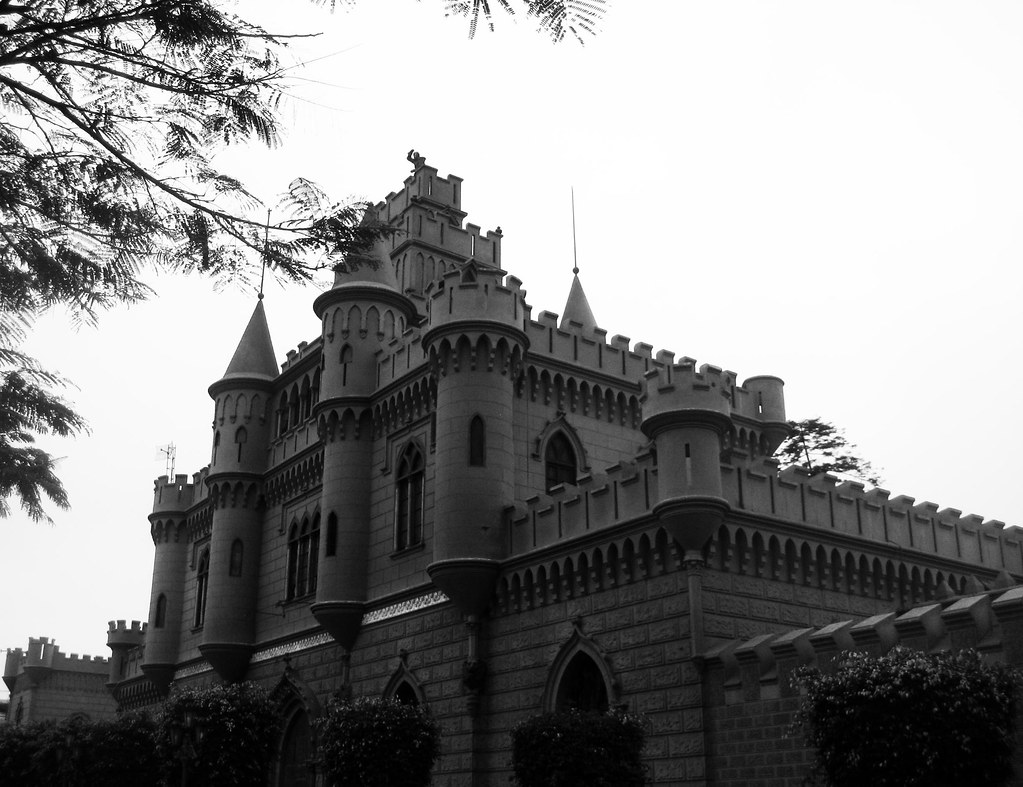
The city of Lima can be considered both a modern city as well as an old colonial city, but did you know it is also host to it´s very own medieval castle! Until recently I had no idea that Lima had a medieval castle, well ok it´s not officially medieval since it was built in 1929 but it can be considered a very impressive representation of one. So how does a turn of the century spanish colonial city come about the idea to build a medieval style castle? The answer is as old as the castle´s history.
Situated in the heart of the urbanized district of Lince at the intersection of Av. Montero Rosas and Av. Manuel Ascencio Seguro, just a few blows from Av. Petit Thouars sits the almost century old castle. The castle takes up an entire block and is hard to miss when driving by it, though well concealed in the vast urban sprawl of Lima. The exquisite castle is embellished with all the recognizable features characteristic of a medieval castle, from it´s multiple turrets to very large drawbridge in it´s entrance. The history of the castle rests on the shoulders of the distinguished, Dr. Carlos J. Rospigliosi Vigil. Dr. Rospigliosi a doctor who specialized in the field of natural sciences and medicine and widely recognized for his works in scientific investigation was also a filthy rich millionaire. It was through news of a visit to Lima by the king of Spain, king Alfonso XIII, (of whom which Rospigliosi maintained a good long standing friendship with) that Rospigliosi enthusiastically set out to welcome the king with the construction of a castle. The task of building a large castle in the city of Lima was not a usual one and was one that met with certain difficulties and opposition during it´s constuction in the late 1920´s.
The castle was intended to be presented as a gift to king Alfonso XIII upon his arrival but destiny had other plans for the castle´s fate. Rospigliosi working hard on the castles construction came across certain building restrictions when he filled with the local municipality to grant him permission to dig a moat around the perimeter of the castle which would in turn serve the function of the installed drawbridge entrance (which was to be the icing on the cake if you will). Unfortunately for Rospigliosi the municipality more than likely having had enough with the elaborate conception of a medieval castle in district denied the grant for a moat, seeing it as excessive.
To make matters worse than they already were, when the construction of the castle was finally completed news of a Spanish revolution was announced with king Alfonso XIII and the Republic overturned. The fall of the Spanish Monarchy led to the inevitable and for obvious reasons cancellation of the king´s scheduled trip to Peru. When Rospigliosi received word on the situation in Spain he decided it was time to cut his loses and fold the cards he had held is hand, seeing no other options for this newly constructed castle Rospigliosi took the only decision he had left and used the castle as his new residence where he and his family resided there after. The castle from that moment on was known as Rospigliosi Castle or Castillo Rospigliosi.
Today the castle is the under the ownership of the Peruvian Airforce (FAP = Fuerzas Aereas del Peru) and is the site of the Airforce´s Escuela Superior de Guerra Aérea or Superior School of Air Warfare.
Here is a link to their site: http://www.fap.mil.pe/instruccion/esfap/nosotros/nosotros.html

I first came to know Centro Camino Real about a few months ago when I started teaching classes in a few of the several commercial and financial torres (towers). It took a few visits before it dawned on me that the Centro was an old shopping mall similar in design to the malls of the US, complete with food court (which is still somewhat active) and a movie theater (which is currently abandoned). Just walking through the wide and largely empty halls of this once highly trafficked mall, you can almost begin to imagine what it was like back in the 80's when it was alive and bustling. Almost all of the stores are abandoned with nothing left but several unpaid bills and notices left behind. Some shops and restaurants still have all their tables and stands, almost as if they were closed for the weekend or something. The feeling you get when you walk through the mall is almost eerie, especially when most of it has been left untouched since the 90's (like Chernobyl). A few stores continue to operate inside of Centro Camino Real these days but it is obvious that most the people who visit are there because of the several private business torres that were build after Centro Camino Real's downfall.
The question that still rattles my mind is what exactly happened to Centro Camino Real to have turned this huge mall in a very popular part of San Isidro into a literal ghost town? In May of 1992, at the height of it's success, Centro Camino Real became the site of an attempted terrorist attack. The attack was conducted using a car bomb to cause $14 million USD in damages along with the death a civilian. The attack was the work of the terrorist group Sendero Luminoso (Shining Path) and was only one of many sites that was targeted that year within the city of Lima (others include: the old US Embassy and the two car bombs in Miraflores). Following the attack fear began to spead among the populace as the number of people who once frequented the mall rapidly declined in response. One of the problems which may have led to it's decline was the development that occurred with both Jockey Plaza Mall in Surco and Plaza San Miguel in San Miguel. Another know problem of Centro Camino Real was that each store was individually owned instead of rented which later proved to be a problem when a proposal was made to sell the mall, leaving many owners at odds on the proposal to sell, which required a unanimous vote. Many companies have offered to purchase the relic mall but unfortunately due to the indecision of the owners no company has yet to acquire it.
I did manage to find some vintage footage of Centro Camino Real from back in the 80's
Tom Filipowicz in Chiclayo gives us our regular dose of virtual tourism with a look into Chiclayo's Past
Article brought to you by Mochica Hostess Tours
 The area Chiclayo occupies today has been populated for thousands of years, beginning with people of whom nothing is known, through several distinct cultures up to the present. The informal founding of Chiclayo took place shortly after the arrival of the Spanish with the construction of Santa María de los Valles de Chiclayo – a Franciscan Monastery begun in 1561. The formal founding (whatever that is) took place in 1720. On April 15 1835 Peruvian president Felipe Santiago Salaverry bestowed the official title of ‘city’ on Chiclayo. For whatever reason he also gave it the honorary title of ‘Heroic City’, which can still be seen on monuments throughout the city.
 Because of my fascination with history I have always loved ‘then and now’ photos. I’ve not been able to locate many historical photos of Chiclayo, though I’m told unknown persons have many of them in unknown locations, so my ‘unknown self’ is going to keep looking. I have driven myself and others crazy trying to date the old photos that follow with no success. Let’s just say they’re old.
The Franciscan Monastery “Santa María de los Valles de Chiclayo” has a colorful history. As mentioned earlier construction began in 1561. On September 24 1859 it opened its doors as the San Jose National school. In 1882 during the Pacific War with Chile, the Chilean army occupied the building. In 1906 the building again served as a school until the late 1980s when a portion of the ancient structure collapsed and three students were killed. Since that time what remains of the once proud structure has been boarded up and allowed to slowly crumble.
The building on the left is now Interbank. The central square looks more like a jungle than a park. Whenever I look at this photo I get a ‘Sunday’ feel from it – the cars casually on parade; the strollers and bench occupiers enjoying their day off.
 The same view from a slightly higher angle. Things change in 100 years or so. What remains of the monastery is hidden behind palm trees in the photo’s center. I spend hours in this park looking and listening. It’s an island of peace surrounded by the hustle and bustle of central city activity.
Avenue Balta North, taken from somewhere near the central park. The banner apparently is informing the populous of an upcoming annual celebration on December 8th of the “Virgin of Immaculate Conception”, a celebration that has been taking place for 300 years. It seems to me that Peruvians have a preoccupation with virgins. Every organization from postal workers to fire fighters has a patron virgin. Tradition has it that the statue of Elias Aguirre in the park bearing his name tips its hat to every passing virgin.
 Avenue Balta North today. The building on the left is the former Royal Hotel, inaugurated in 1930. Just this year it became a Ripley Department Store, one of a huge chain of stores owned by a Chilean conglomerate. The city office building on the right was constructed between 1919 and 1924. Extensive remodeling has recently been completed.
Avenue Elias Aguirre looking east from the intersection with Avenue Balta South. Construction on the Santa Maria Cathedral was begun on February 13 1869. It was consecrated 90 years later in 1959. The road gets its name from Elias Aguirre who was a prominent figure in the Pacific War with Chile. Another important figure in the Pacific War was Jose Leonardo Ortiz. His home still exists today (red arrow) and is designated an historical monument.


If you’d like to experience events like this and get a taste of real daily life in northern provincial Peru, speak to Tom & Maribel via Mochica Hostess Tours


Yesterday was a national holiday here in Peru which meant no work :). In Peru the 8th of October is a celebrated holiday that pays respect to the famous Peruvian Hero and Legend, Admiral Miguel Grau Ceminario.
The 8th of October is the historical date for the Battle of Angamos which took place in 1879. The naval battle took place in Punta Angamos, which once belonged to Bolivia and is now part of Chile. El Huáscar and La Unión (peruvian ships) were traveling north along the Chilean coast after having completed several offensive operations on Chilean ports in an attempt to disrupt the countries war economy, when they noticed the smoke of several enemy(Chilean) ships in the distance. The Chilean Naval 1st division which comprised of Blanco Encalada, Covadonga y Matías Cousiño had been heading south along the Pacific coast when they spotted El Huáscar and La Unión traveling in the opposite direction and proceeded to close the pass. In response to Grau's operations in the south the Chilean Navy had put out an order of engagement and capture against the Rear Admiral. 

Grau taking into account the size and superiority of the opposition decided to use evasive maneuvers to outrun the enemy. As El Huáscar and La Unión sailed north in attempt to reach Peru they ran into more opposition as they spotted the Chilean Naval 2nd Division (Cochrane & O'Higgins) about 22 miles (Not sure what this is in Nautical terms) away. Grau realizing that La Unión could outrun the other ships he gave the order for La Unión to push on ahead.
Here is a link to an interactive illustration of the battle, click on animacion to view: LINK
Left with no other option but to fight, El Huáscar opened fire on the Cochrane who didn't retaliate. Instead the Chilean ships waited until they were in range of the Peruvian ironclad before they opened fire (the Chilean Ships were of the latest in English design and technology and were armed with the latest weaponry...Armor piercing rounds that explode once they penetrate). One of the shot's from the Cochrane pierced the bridge of El Huáscar killing Rear Admiral Grau and 1st Lt. Diego Ferre. The heavy shelling of El Huáscar left the vessel's armaments destroyed and it's crewmen dead and injured. One by one the ship's officer's took command of the ship and one by one were killed. By the time Lt Pedro Garezon assumed command of El Huáscar, the ship was in an inoperable state with the wheel damaged and the ship unable to be controlled. The remaining officers decided to sink the ship before the enemy could take hold of it. The order was given and the ship's valves (cockholds) were opened to allow water to enter and flood the ship. The Chilean's noticing that the ship has slowed down in its paced decided it was a good opportunity to capture El Huáscar. The Chilean's managed to board the ship and quickly ordered the remaining crew to close the valves (the engine room had about 1.2 meters of water in it). 
With El Huáscar out of commission and in the possession of the Chilean forces the seas were open for the Chileans to proceed into Peru and Bolivia where the war would be taken to land.
For his heroic actions in the face of innumerable odds, Rear Admiral Grau was promoted to Admiral and is to this day recognized and celebrated as a Hero to the Republic of Peru.




